Unlocking Opportunities for Ghana’s Youth: Projections and Challenges for the Next Decade
This decade [2020 – 2030] marks a golden period for Africa’s youth. According to World Data Lab projections, the continent’s youth population (aged 15 – 35) is set to grow from 474 million to 608 million by over 130 million, which means that by 2030 nearly one out of every four of the world’s youth will be African. In Ghana (2023), the 11.8 million youth population I) represents over one in every third (36%) person within the country’s 32.6 million population, and II) will account for 0.5% of the projected global youth population (2.4 billion) and 2.2% of Africa’s projected youth population (608 million). Establishing a clear understanding of these population dynamics at the country level, and their implications for socio-economic outcomes, is central to active and engaged policy discussions around youth employment in Ghana.
 by World Data Lab | 10min read | June 2024

Figure 1: Ten-Year Population Growth Projections (Ghana Vs. Africa Vs. Rest of the World)
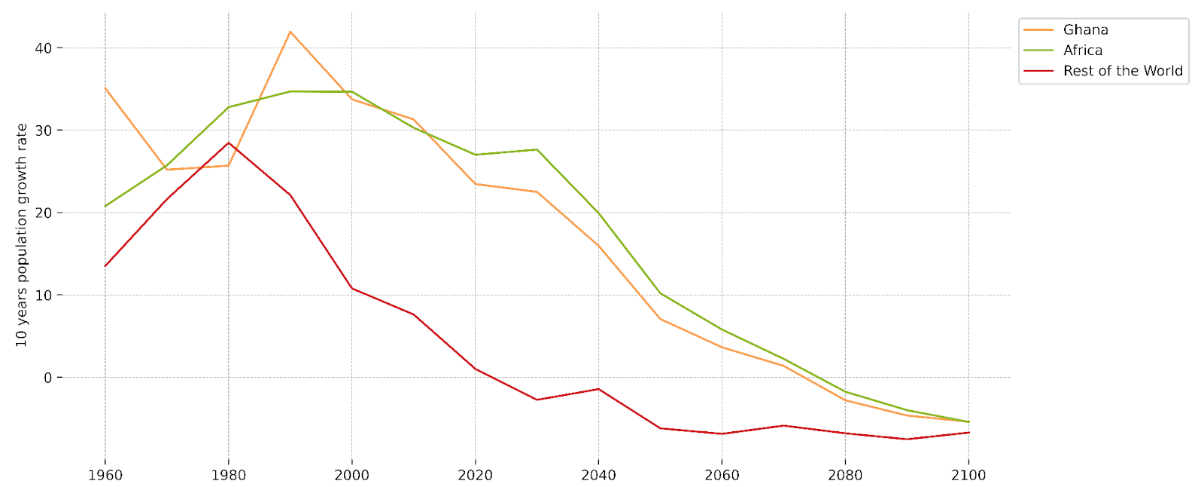
Source: International Institute for Applied Systems Analysis (IIASA)
To help contextualize and inform these discussions, granular and data-driven insights into the African youth population, and how it will change in the future, are key. The Africa Youth Employment Clock is a digital tool that offers such insights. The Clock monitors real-time job growth and forecasts employment trends for African youth through to 2030. For the first time, it brings together labour market statistics in a consistent, credible, and comparable format for all African countries, making it a unique tool to support evidence-based policies and decision-making.
With the fastest-growing share of young people in the world, an important question for African countries is: What is needed to create the opportunities young women and men aspire to across diverse African countries and economies? In this article, we review labour market data from Ghana, drawn from the Africa Youth Employment Clock, and discuss how it helps identify the critical issues around job opportunities for youth.
The starting point for considering where future jobs for young people will come from is to consider the existing employment composition. This is especially useful in Ghana, given the youth’s high population share. Encouragingly, the data show that Ghana has a better-than-average ability to absorb youth into employment relative to other African countries, and compared to the global average. Overall, 57% of Ghanaian youth are currently employed, compared to 52% in the rest of Africa, and 48% in the rest of the world. This is coupled with a lower share of the youth population who are not in employment, education, or training (NEET) – only 23% of Ghana’s youth population are classified as NEET, relative to a rate of 26% in the rest of Africa.
The fact that most young people in Ghana are employed is promising, but what do we know about the various types of work they are engaged in?
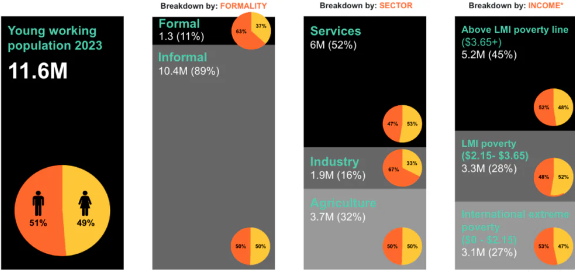
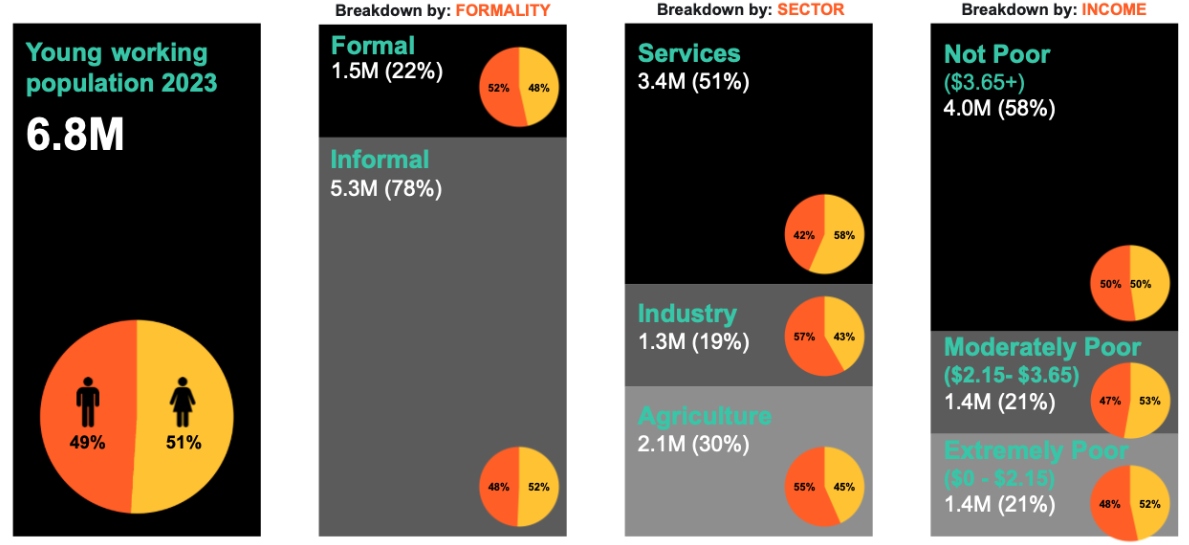
Figure 2: Youth employment by formality, sector, and income in Ghana
Source: WDL estimates based on the Ghana Statistical Services surveys, ILO and IIASA (2023). Income defined according to the World Bank’s (2024) lower-middle income poverty line of USD 3.65 per day (in 2017 Purchasing Power Parity (PPP) terms).
Firstly, similar to most African countries, work for most young people in Ghana is informal in nature, accounting for 78% of total youth employment in the country. This is marginally lower than the African average of 85%, but well above the global average of 60% (Bonnet, Vanek and Chen, 2018). Informal employment is more precarious than formal employment in that it is typically less well-paid, and has poorer working conditions. While not shown here, the data suggests informal employment is dominant across all sectors in the country but that its intensity varies considerably. For instance, almost all youth in the agricultural sector are informally employed (94%), compared to 80% informality in industry, and 68% in services. By gender there is very little difference – the share of young women and men in formal and informal employment is similar.
Secondly, a unique feature of the Ghanaian economy is that the dominant sector of employment is services, which is where over half (51%) of all youth are employed. Another 19% work in the industrial sector, while the remaining 30% are in agriculture. This composition is similar to global averages, but differs considerably from most African countries, where approximately half of all youth workers are in agriculture and just 38% work in services.
Finally, using household income as a proxy for labour market earnings, we find that despite relatively high levels of employment, approximately 42% of all employed Ghanaian youth earn below the World Bank’s Lower-Middle Income (LMI) poverty line of USD 3.65 per day (in 2017 PPP terms). Moreover, over one in every five (21%) of Ghana’s working youth are classified as living in extreme poverty, where this is based on the World Bank’s International Extreme Poverty Line of USD 2.15 per day. This is suggestive of a relatively high degree of “working poverty” among Ghana’s youth, and is likely linked to the large share of youth employed in the informal economy. It is important to note that these World Bank poverty lines are defined to compare poverty internationally and they do not take into account any national measures of poverty. Nevertheless, the poverty levels they reveal are striking and underline the challenge to create higher quality work for young people in Ghana which provides higher, more reliable incomes.
Looking ahead to 2030 based on existing projections we expect to see youth employment in Ghana increase by approximately 700 000 or just over 10% in total. However, in order to keep Ghana’s youth employment-to-population ratio constant (at 57%), at least 900 000 net jobs would need to be created. This suggests that youth employment opportunities in Ghana are growing more slowly than the youth population. Of course, if these additional “non-employed” youth are being channelled into education then this slightly slower growth in youth employment may not be a major concern. Certainly what the data highlights is the importance of monitoring Ghana’s NEET rates carefully to ensure they do not begin to climb unsustainably.
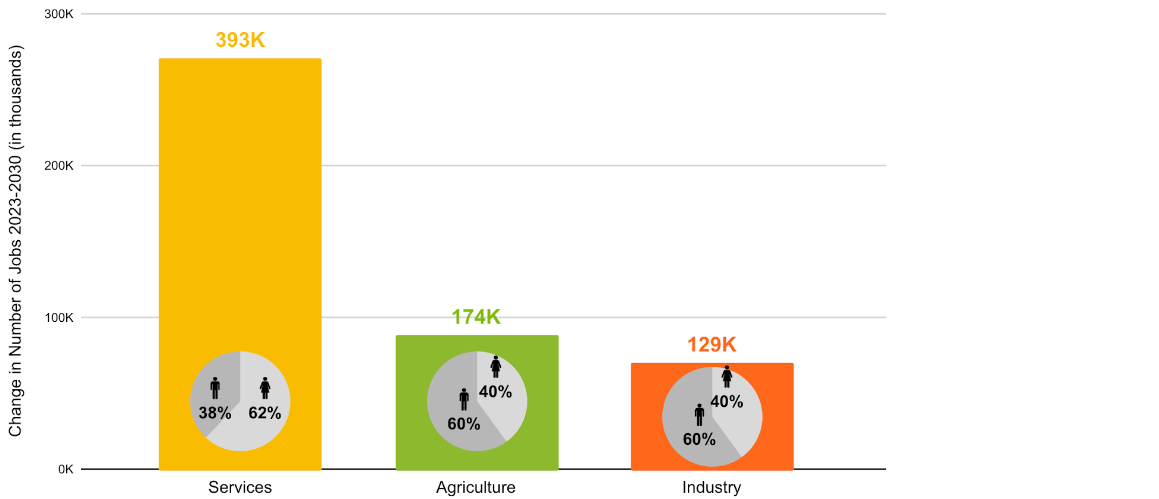
The way that Ghana’s sectoral employment composition is projected to evolve is also useful to examine. As shown in the figure below, we expect that of the approximately 700 000 new youth jobs created by 2030, more than half (57%) will be in the services sector, cementing the centrality of services in youth employment. We project positive but lower growth in both agricultural and industrial employment, with youth employment becoming marginally less prevalent in the former. The major sub-sectors in services that contribute to the projected growth include education, human health and social work, wholesale and retail trade, and accommodation and food services.
Figure 3: Projected new youth jobs in Ghana by sector
Source: WDL estimates based on the Ghana Statistical Services surveys, ILO and IIASA (2023).
The final element of Ghana’s youth employment composition that we examine are trends in gender and education. With regard to gender, knowing that most employment opportunities over the next few years will be concentrated in services allows us to examine how this growth aligns with goals of gender equity over time. The services sector in Ghana has a much larger share of women – approximately 58% of youth in the sector are female – and as a result growth in services will support increasing female economic participation over time. On the other hand, youth employment in the industrial and agricultural sectors are predominantly male (57% and 55%, respectively). If this reflects certain barriers to entry for women, it may require greater policy attention to ensure that women are afforded employment opportunities in these sectors.
In terms of education, the Ghanaian workforce has a relatively high share of formal education compared to the broader African continent. Currently, 76% of all employed Ghanaian youth have at least a completed secondary education level. This level of educational attainment is promising from the perspective that it can open opportunities in growing sub-sectors within services where returns to education are likely to be higher. However, it is critical that the education being offered to young people is well-aligned with changing sectoral skills requirements. Doing so effectively will enhance smooth transitions into the labour market, with fewer skill gaps or mismatches amongst new hires.
To conclude there are a number of key stylised facts that emerge from the data, and below we combine these to suggest that Ghana’s youth labour market can be helpfully characterized by three main factors.
- Youth employment is concentrated in a large and growing services sector, making up approximately half of all current employment, with a concentration in the informal sector. Our projections to 2030 suggest that most new net jobs created will come from these sectors.
- The youth population in Ghana has a relatively low proportion of NEETs compared to the African continent. Most young people are either in some form of education or are working. A concern then is around the quality of work, given the high rates of informality, and the extent of working poverty.
- Employed youth are relatively well educated, with generally high levels of educational attainment relative to comparable countries on the continent, for both men and women. This suggests that there is a good foundation for shifts towards more productive work as the Ghanaian economy continues to grow. This profile is projected to continue to shift in favour of higher education levels.
These stylized facts are relevant when considering the challenge of providing fulfilling work for young people in Ghana, and provide a baseline from which to better target the types of jobs that are created in the coming years, or where possible, use relevant policies to ensure that the aspirations of young Ghanaians are matched with available employment opportunities.
References
Bonnet, F., Vanek, J. and Chen, M., 2018. Women and men in the informal economy: A statistical picture. Third edition. International Labour Office: Geneva. Available: https://www.ilo.org/wcmsp5/groups/public/---dgreports/---dcomm/documents/publication/wcms_626831.pdf
World Bank, 2024. Poverty and Inequality. World Development Indicators. [Online]. Available: https://datatopics.worldbank.org/world-development-indicators/themes/poverty-and-inequality.html
World Data Lab (In Partnership with the Mastercard Foundation). Africa Youth Employment Clock. (https://africayouthjobs.io/; accessed April 2024).
International Standard Industrial Classification of All Economic Activities (ISIC) (2024) ILOSTAT. Available at: https://ilostat.ilo.org/methods/concepts-and-definitions/classification-economic-activities/
The articles were produced in the context of the Africa Youth Employment Clock in partnership with the Mastercard Foundation. The views expressed do not necessarily represent those of the Foundation, its staff, or its Board of Directors.